
My Writing
An inspirational quote.

Story Structure
A Handy Guideline in 9 Plot Points
12 March 2020
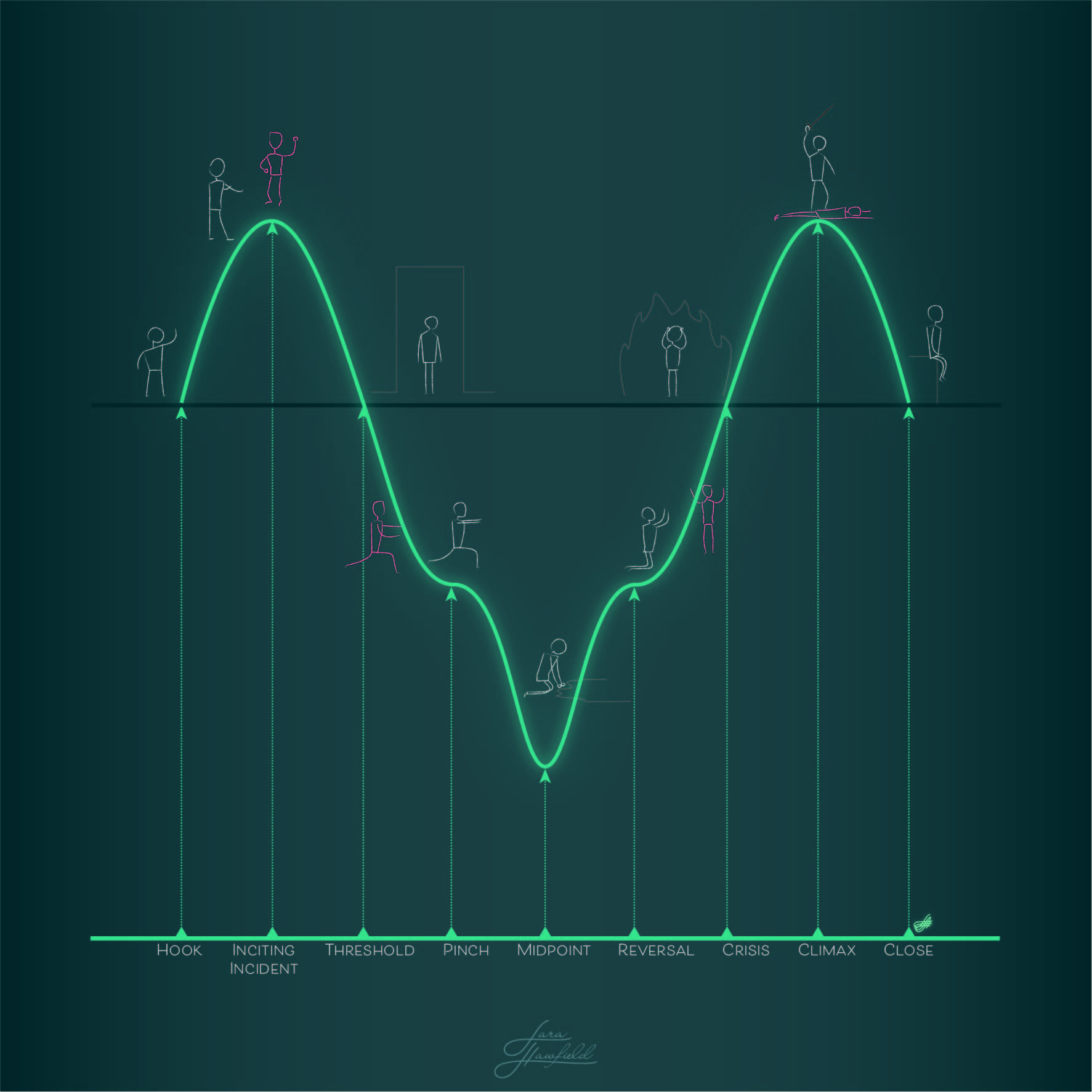
Can it be considered wise to dispense advice before you have anything substantial to show for yourself? Maybe not. But the most freeing moment in my writing journey to date was my discovery of outlining. What, writers don't just make shit up as they go? Inconceivable. But hear me out. If I might help just one writer out there by chiming in on the subject of plotting vs. pantsing and story structure, then I will sure as hell try.
...
For years I struggled with the notion that creativity behaves much like sunshine in, say, Britain: every six months or so a ray will graze your head and magically shed enlightenment on your sorry writer's soul. And I'd write it down dutifully. But with no plan, no guideline, no birds-eye view, it always ended right there. A burst of creative excitement and then another six months of the inconsolable feeling of being utterly lost for words.
My next discovery changed writing forever for me: stories aren't just a series of events happening to a character in any random way. There is a design to storytelling, and some generous people even codified it by writing books about Story Structure. Mind you, everyone seemed to have their own terms and codes, so I figured I might as well mix and match until I have my very own blueprint of build-up culminating in an event. Those events are what our reading brain retains most clearly of a story once the book is closed. The points of change.
The result of some fun times I had in Illustrator is the lovely curve in the picture above this post. You are given maxima, minima, saddle and inflexion points. Discuss* (Isn't differential calculus fun?).
In all seriousness, viewing story like this satisfied a part of my brain that needs to know the purpose behind a scene in order to use that scene to full effect. The 9-point structure I laid out answered this need beautifully. It became obvious when an antagonist was absent for too long; everything is going too smoothly for the protagonist for too long; the emotion in a scene is tepid at best when it should really peak. The rules of the game change for the characters as you are pushing them through doors or challenging them to cross through fire, and it should feel that way too. Maybe not everyone thinks as much in graphs and figures as I do, but maybe your writing can also be informed by actually seeing the plot fluctuate between action and reaction.
I plan to go through the plot points individually, possibly even alongisde my most current work-in-progress. The one I vow not to abandon even when the creative fuel runs low. Others have of course talked structure before me. To single out one invaluable introduction to story structure, I will point to K. M. Weilands Structuring Your Novel: Essential Keys for Writing an Outstanding Story.
*Don't, under any circumstances, actually try. This is not a sensible curve. Iterate if you must.
Live and Learn: Am I Truly Good Enough?
So you are struggling to write...
20th June, 2020

Reddit can be a wonderful place for beginning writers. It has one of the lowest entry barriers; anyone get get a reply on reddit if the question catches someone's eye. If you ever engaged in the shouting matches on Twitter or tossed your posts into the void on Instagram, that feature of reddit becomes very important when you're just starting out. It is impersonal, no one goes by their real name, and you don't follow people, you subscribe to topics.
If you've been on there for a while though, you start to notice the many, many variations on just a handful of questions in the main writing subreddits. Can I do this? How do I overcome my resistance? Am I truly good enough? It's easy for other writers to get fed up by reading the same questions again and again, but I like to remind myself regularly that I was a bloody beginner once too. This is a reply I left on reddit with some of my thoughts to help struggling writers.
...
Here‘s an incomplete list of things I have to periodically remind myself of:
(1) any published writing I read has been reshaped, revised, reviewed by the hands of the author and editor(s), has seen reader feedback and was still further revised, has made it past reviewers and critics until it reached me. My first draft of anything is just that: my first draft.
(2) I alone decide what will ever leave the insulation of my brain/my computer to see the light of day and when it‘s the right time to do so. Until I hit „send“ or „publish“ no one will see a word of what I‘ve written and the changes I made.
(3) When I do share something of my work and it is received badly, I can withdraw it again, rework it. That one person‘s opinion will move into the past and turn obsolete as I keep working. Market distribution is a long, long, l o n g way off.
(4) You become a better writer with every word you write, every new technique you try, every bit of feedback you analyze and choose to incorporate. We naturally evolve with time, regression is what happens when we ward ourselves off too strictly from perceived danger.
(5) Rejection is painful. Preparing yourself for rejection is self-preservation. Basing decisions on rejection that you never heard but your brain expects to hear is self-sabotage.
Our brain is wired to protect us. If you are afraid of rejection, of failure, of exposure, it will do whatever it has to do to spare us from what we fear. Even if it deprives you of something you want. Even if the reason for your fear is disproven by positive feedback and compliments on your work.
When your brain pulls up these defenses, hang a bright, shining lantern on it and recognize what you are doing: protecting yourself against your better judgement. Every time that lantern flares up, look at it and remind yourself. Do you need, or even want, that level of protection?
Human behaviour change is much harder than fictional character change arcs. You will walk into the trap again and again, and it‘s not because you‘re stupid, but because it‘s what our monkey brain is wired to do and think. Do it again, and again, and again. Think about your thinking to change it over time.
I hope this helps. It‘s the outcrop of years and years of therapy, mind you. Just keep at it and don‘t forget to have some fun with what you‘re doing in the privacy of your own mind.